ENVIRONMENT STRATEGY
1. Weightage given to Environment
2. How to Prepare
3. Biodiversity and Conservation
4. International and Indian laws/Bodies and Policies
5. Environmental Terminologies and issues related with pollution/water conservation etc
6. Current Environmental Issues
7. Sources to Prepare
8. Previous Years UPSC Questions and Solutions
2. How to Prepare
3. Biodiversity and Conservation
4. International and Indian laws/Bodies and Policies
5. Environmental Terminologies and issues related with pollution/water conservation etc
6. Current Environmental Issues
7. Sources to Prepare
8. Previous Years UPSC Questions and Solutions
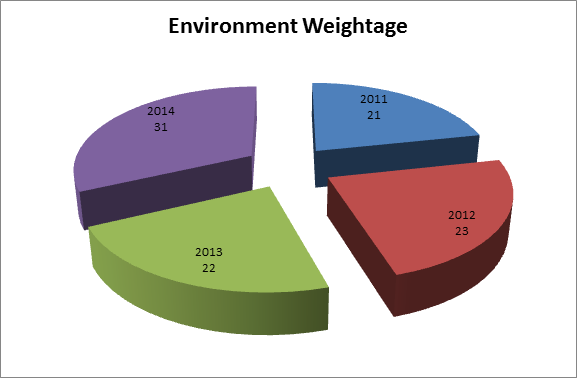
With the change in format since 2011, UPSC is constantly giving more weightage to ‘Environment Section’. There can be various reasons to it from inclusion of Indian Forest Services (IFoS) to increasing worldwide environmental concern.
Weightage given since 2011:
The importance of Environment can be seen from the fact that it constitutes around 25-30 percent of the general studies, paper 1. Skip this at your own risk.
How to Prepare
There are many books and coaching notes in the market but seeing the dynamic and unpredictable nature of the subject, there is no concrete material available. Considering this many aspirants find it difficult to prepare and lose substantially in Prelims. It is very important to know the basics from the NCERT texts or any book, but is that sufficient?
In this article we are going to deal with following aspects without detailing the syllabus. Many aspirants start on a higher note but without knowing the need or essence, they get stuck in between and lose energy. This costs them severely and the vicious cycle of preparation goes on.
Let us address the issues going to be covered
What to read?
- The most important aspect of preparation is sources and resources that build your confidence as well as chances.
- Basic texts like NCERT’s- Geography from 6th and 12th and Biology, 12th (Old and New)
- You can also refer to ICSE books – Class 10th and 11th
- The Hindu, Down to Earth and Science Reporter
Keep this in mind while preparing for Environment
- A simple approach for environment related topics is a mix of static and dynamic portion.
- Here we will not tell you to exhaustively cover everything on earth but to simply relate and learn in a smarter way.
- While going through the article, you will know how to pick issues from newspapers and relate it to static portion.
- It is to make your life easy. Make sure that your preparation is as easy as it could be. There is nothing to panic in life. At least environment section should not panic you after going through this.

How to pick issues?
- It is explained later in this article.
- The purpose of this article is to make you understand the diverse nature of this section and how it can be fine tuned with right approach.
- We have not explained elaborately on what topics are important or what not (unlike the Core subjects like Polity, Geography, Economics, History) as this section needs a strategy different from the Core subjects. If we tell you to focus only on certain aspects, then you will be taken for a ride. So, what we have done is, we have chalked out a path, for you to make the right choices and cover this section smartly.
Note: In almost every book one can find the syllabus and aspects related to Environment. We will not indulge into it rather concentrate broadly on how to tackle the questions and chalk out relevant issues to be prepared.
Broadly UPCS questions are based on following front. We will take examples from previous year papers and then pick relevant issues from newspapers to understand the nuances of preparing ‘Environment’.
Topics range from:
- General issues on Environmental Ecology– ecological terms like Ecotone, Ecological niche ecosystem, effects of environmental deterioration, how it affects human being. Food chain in the ecosystem.
- Pollution – Acid rain, Photochemical smog, Green House Gases (GHG’s), Ozone hole, algal bloom.
- Bio-diversity (which also overlaps with topics from Geography)- why biodiversity is important for human survival, International Union for Conservation of Nature and Natural Resources (IUCN) – Red Data Book, Biodiversity Hotspots.
- Conservation- Conservation of natural resources, National Parks, Wildlife conservations, Wetlands, Biosphere Reserves etc. – internationally recognized Wetlands and Biosphere Reserves of India.
- Sustainable Development– renewable energy, Biotechnology (bio-fertilizers, bio-pesticides), Biomass gasification.
- Ecologically sensitive areas – Western Ghats, Himalayas.
- Climate Change – mitigation measures taken at national and international level (Kyoto protocol, Montreal protocol) recent climate change summits held, objectives of the summits.
- Laws, Regulatory Bodies and Policies at national and international level: Environment Protection Act, Forest Right Act, National Biodiversity Authority, Protocols and Summits like Cartanega Protocol, Nagoya Protocol and Lima Conference etc.
- Intergovernmental Organizations, Treaties and Conventions related to climate change, biodiversity- Ramsar Convention, Montreux Record, The three Rio Conventions—Convention on Biological Diversity(CoB), United Nations Framework Convention on Climate Change (UNFCCC) and United Nations Convention to Combat Desertification – from the 1992 Earth Summit) etc.
- Organisations like UNEP, FAO, UNESCO etc.
Note: Google for the latest updates on the recent treaties and updates taken at the national and international level with regard to Climate Change, Conservation and Biodiversity
Use ‘Orient BlackSwan School Atlas’- Page No. 35 for finding the location of the Conservation sites, rivers flowing near-by, hills. Since, atleast 2 questions are frequently asked every year in the Prelims Exam.
Consider an example from 2014 question paper
| Consider the following pairs1. Dampa Tiger Reserve : Mizoram
2. Gumti Wildlife Sanctuary : Sikkim
3. Saramati Peak : Nagaland
Which of the above pairs is /are correctly matched?
A. 1 only
B. 2 and 3 only
C. 1 and 3 only
D. 1, 2 and 3
Solution: C
|
Biodiversity and Conservation
Focus
- Concentrate on types of biodiversity
- Methods to protect biodiversity in India
- Causes of biodiversity loss- Climate change, invasive species, habitat change etc
- Marine, Animal and Plant Biodiversity
- Protection Networks- Wildlife Sanctuary, National Park and Bio-reserves
- Biodiversity Hot Spots-India and World, criticism against hotspots
- Bioprospecting and Biopiracy issues
- International Conservation initiatives and India- Cartanega and Nagoya Protocol
- Laws and Policies- India and World, Convention on Biodiversity, Aichi Targets,
- Biodiversity Act, 2002.
- Read Environment chapter of India Year Book
Few Examples from Previous Year Question Paper’s
The Himalayan Range is Very rich in species diversity. Which one among the following is the most appropriate reason for this phenomenon?(2011)
(a) It has a high rainfall that supports luxuriant vegetative growth
(b) It is a confluence of different bio-geographical zones
(c) Exotic and invasive species have not been introduced in this region
(d) It has less human interference
Solution (b)
|
| Consider the following pairs (2013)1. Nokrek Bio-sphere Reserve : Garo Hills
2. Logtak (Loktak)Lake : Barail Range
3. NamdaphaNationalPark : Dafla Hills
Which of the above pairs is/are correctly matched?
(a) 1 only
(b) 2 and 3 only
(c) 1, 2 and 3
(d) None
Solution (a)
|
Note: A factual question. Though it requires basic concepts but can you remember endless things from books? While going through newspapers try to find out any such news that fall under this domain and remember the locations or any relevant information as such.
We will explain with an example. Taken from The Hindu
Recently there were articles related to ‘Arctic Council’. You would have read about the issue. The most important and debated issue is of ‘Global Commons’. Unlike Antarctica, Arctic is not considered as Global Commons. Mainly the articles were inclined towards India getting an Observer Status. But Prelims related stuffs can be prepared because it falls under environment.
| According to international laws, what constitutes “Global Commons”1. Outer Space
2. High Seas
3. Atmosphere
4. Antarctica
5. Arctic
6. Cyber Space
Choose the correct codes
(a) 1,2, 3 and 6
(b) 1, 2, 3 and 4
(c ) 1, 3, 4 and 5
(d) 1,2,3,4,5 and 6
Solution: B
|
Government of India encourages the cultivation of ‘sea buckthorn’. What is the importance of this plant? (2012)
1. It helps in controlling soil erosion and in preventing desertification.
2. It is a rich source of biodiesel.
3. It has nutritional value and is well-adapted to live in cold areas of high altitudes.
4. Its timber is of great commercial value.
Which of the statements given above is /are correct?
(a) 1 only
(b) 2, 3 and 4 only
(c) 1 and 3 only
(d) 1, 2, 3 and 4
Solution (c )
|
Note: The source of this question is ‘Nothing but newspaper’. That year (in 2012) ‘sea buckthorn’ was in news because of National Mission on Sea buckthorn and specific plant to a region (Leh-Ladhak) having immense medicinal properties.Let us consider this question from UPSC
Now let us consider a similar question from recent current affairs
| Rhodiola has been a significant herb of research interests among the scientist all over the world. Consider the statements w.r.t Rhodiola1. It is approved by FDA to cure, treat or prevent disease
2. It has proved significance as anti-depressant
3. It has immunomodulatory, adaptogenic and radio-protecting abilities.
4. The leafy part can be used as vegetables
5. It is found in cold regions only
Which of the following statements is /are correct
(a) 1, 2,3 and 5
(b) 1, 3 and 4
(c ) 2,3,4 and 5
(d) 1, 2 and 3
Answer: C
|
International and Indian laws/Bodies and Policies
Focus:
- Concentrate on recent meetings and United Nations initiatives.
- Indian policies in news like Environment Protection Act and Bodies/Committees under it like GEAC or Pollution Control Act-any changes or modifications therein. Additionally focus on recent issues related to any environmental bodies.
- Terms like Kyoto mechanism, Emission Trading etc.
- Carbon Trading and Leakage issues
- Wetland conservation initiative- UPSC is asking too many questions from wetland from past two years.
- Ramsar Convention, Montreux Record
- The three Rio Conventions—Convention on Biological Diversity(CoB), United Nations Framework Convention on Climate Change (UNFCCC) and United Nations Convention to Combat Desertification – from the 1992 Earth Summit) etc. Note that these are for Sustainable Development
- Organisations like UNEP, World Bank, FAO, UNESCO etc. and their environmental initiatives & reports. For example BioCarbon Fund Initiative of World Bank, IUCN by UNESCO, Global Environmental Facilities, Green Bonds & Green Climate Funds etc.
Example (2014 Prelims Questions Paper)
| With reference to ‘Global Environment Facility’, which of the following statements is/are correct? 20141. It serves as financial mechanism for ‘Convention on Biological Diversity’ and ‘United Nations Framework Convention on Climate Change’.
2. It undertakes scientific research on environmental issues at global level
3. It is an agency under OECD to facilitate the transfer of technology and funds to underdeveloped countries with specific aim to protect their environment.
4. Both (a) and (b)
Answer: 1
|
Note: On the same line, here is a question from recent current affairs. Have a closer look.
| With reference to’ Green Climate Fund’, which of the following statements is/are correct?(a) It will support projects, programmes, policies and other activities wrt climate change in all developing countries.
(b) Severely affected countries are eligible to receive resources from GCF
(c) GCF board comprises of members from all the countries party to UNFCCC
(A) a and b
(B) b and c
(C) a,b and c
(D) None
Answer: None
|
Note: Compare the above questions, you will understand it’s essence and how the questions are framed. Still, if you have not understood, then let’s proceed further…Check these questions from UPSC. All are more or less on similar lines. You just need to understand the theme on which they have been prepared and then base your preparation accordingly.
| Consider the following kinds of organisms :(2012)1. Bat2. Bee
3. Bird
Which of the above is/are pollinating agent/agents?
(a) 1 and 2 only
(b) 2 only
(c) 1 and 3 only
(d) 1, 2 and 3
Solution (d)
|
| Consider the following: (2014)1. Bats2. Bears
3. Rodents
The phenomenon of hibernation can be observed in which of the above kinds of animals?
A. 1 and 2 only
B. 2 only
C. 1, 2 and 3
D. Hibernation cannot be observed in any of the above
Answer: C
|
Note: Now check this question from recent current affairs and articles
| Which among the following are ‘Nocturnal’ in nature?1. Bat
2. Catfish
3. Kiwi
4. Koala
a) 1,2 and 3
(b) 1,3 and 4
(c) 1,2,3and 4
(d) Only 1
Answer: C
|
Note: Have you prepared such questions from NCERT’s or any coaching material? If yes, well and good and if not, a big reason to introspect.
Let us see how UPSC frames questions on Policies and acts from this section
2014
| 1. Animal Welfare Board of India is established under the Environment(Protection) Act, 19862. National Tiger Conservation Authority is a statutory body.3. National Ganga River Basin Authority is chaired by the Prime Minister.
Which of the statements given above is/ are correct?
a. 1 only
b. 2 and 3 only
c. 2 only
d. 1, 2 and 3
Solution: b
|
Note: There are numerous laws and policies. How to prepare all of them? You cannot do it for sure. But yes, you can prepare smartly from daily exercise. How?
Let us check from recent current affairs
Note: You will find several environmental acts in newspapers. Try to prepare like this.
| Consider the statements with reference to ‘Central Pollution Control Board’1. It is a statutory organization
2. Constituted under Air(Prevention and control of Pollution)Act ,19743.
3. It is responsible for implementation of legislation relating to prevention and control of environmental pollution.
Correct statement is/are
(a) Only 1
(b) 1 and 2
(c) 1 and 3
(d) 1,2 and 3
Answer: 1 and 3
|
Environmental Terminologies and issues related with pollution/water conservation etc
Focus
- Many questions from this section have appeared in UPSC prelims. For example Ecotone, Coral Reefs, Carbon Credits, Edge Species etc
- Problems of Persistent Organic Pollutant
- Acid rains- Content and impact
- Ozone depletion- Atmospheric ozone
- Global Dimming
- Eutrophication- Water pollution
- Diseases- Minamata and silicosis etc
- Biomagnification, Bioaccumulation and Bio-concentration
- Bioremediation
- Issue of Oil Zappers
Let us check one such question asked in 2011
Regarding “carbon credits”, which one of the following statements is not correct?
(a) The carbon credit system was ratified in conjunction with the Kyoto Protocol
(b) Carbon credits are awarded to countries or groups that have reduced greenhouse gases below their emission quota
(c) The goal of the carbon credit system is to limit the increase of carbon dioxide emission
(d) Carbon credits are- traded at a price fixed from time to time by the United Nations Environment Programme
Solution (b)
|
Note: Now let us follow questions from recent current affairs and see whether we can form questions on such themes. These terms were in news for sometime
Consider the following with respect to ‘EDGE’ species.
1. These species have few close relatives and are often extremely distinct in the way they look, live and behave.
2. These unique species are also on the verge of extinction, and if they disappear there will be nothing like them left on the planet.
Select the incorrect option
(a) Only 1
(b) Only 2
(c) Both
(d) None
Answer: None
|
Current Environmental Issues
Focus:
- Indoor Air pollution- Air Quality Control
- Land Degradation and Land use
- Formation of Ground Level Ozone
- Bharat Stage Mission
- National Water Policy
- Solid Waste Management
- Use of Plastics
- Marine Pollution and impact on Coral reefs and Lagoons
- Polar Amplification
- Ocean Acidification and impact
- Water and Carbon Footprints
- Ecological Debts
- Organic Farming and Vermi-compost etc
Let us check some questions based on current events.
Consider the statements with reference to ‘Blue Carbon’
(a) It is carbon stored in coastal, terrestrial and marine ecosystem
(b) The Blue Carbon Initiative currently focuses on carbon in coastal and terrestrial ecosystems – mangroves, tidal marshes, sea grasses and forests
(c) The rates of blue carbon sequestration and storage capacities in ecosystems are comparable to (and often higher than) those in carbon-rich terrestrial ecosystems such as tropical rainforests and peatlands.
Correct code/s
(a) Only 1
(b) Only 3
(c) 2 and 3
(d) 1,2 and 3
Answer: b
|
Note: Be attentive to read about any controversial issue. For example, all of you must be aware about ‘Mid Day Meal’ Mishap. Now see the question that can be part of environment
Consider the statements with respect to ‘Monocrotophos’ believed to be a cause of mid day meal mishap.
(a) It is non biodegradable pesticide
(b) It has high environmental persistence and make the soil toxic
(c) It leads to bioaccumulationCorrect code/s
(a) Only 1
(b) 2 and 3
(c) 1,2 and 3
(d) None
Answer: None
|
Monocrotophos is principally used in agriculture, as a relatively cheap pesticide. However, it is also used frequently used as a tool to commit suicide. It is acutely toxic to birds and humans. Being also a persistent organic pollutant, it has been banned in the U.S. and many other countries.
Source to Prepare:
- We will never guide you or make you restrict your choices. There are people who qualify without even reading NCERT’s or any most followed resources.
- The key to their success is smart study. They spend more time in chalking out what not to study than what to study.
- If they follow one resource, they keep on revising from the same along with complementing it with dynamic updates.
- If you trust your resource, please stick to it. Never rush to fascinating books or suggested resources that are never ending. You are bound to fall. Because you are running behind them.
- STATIC: Basic source or say, best source is NCERT- Geography-Class 6th to 12th and Biology-Class 11th and 12th (Old and New)- A must read and ICSE books – Class 9th, 10th, 11th
- Indian Year Book-Environment and Geography Chapters
- DYNAMIC: The Hindu and Down to Earth.
No comments:
Post a Comment