Polity Strategy
- 3.1 Constitution – Historical Background, Making of the Constitution, Philosophy of the Constitution
- 3.2 Union and its Territory
- 3.3 Citizenship
- 3.4 Fundamental Rights (FR) [ Part III ]and Fundamental Duties[ Part IV-A ]
- 3.5 Directive Principles of State Policy (DPSP) [ Part IV ]
- 3.6 Amendment of the Constitution
- 3.7 Union Government, Executive and Parliament
- 3.8 State Government- State Executive and State Legislature
- 3.9 Administration of Union Territories (UT)
- 3.10 Administration of Special Areas
- 3.11 Federal System
- 3.12 Inter-State Relations
- 3.13 Emergency Provisions
- 3.14 Judiciary
- 3.15 Constitution Bodies
- 3.16 Non-Constitutional Bodies
- 3.17 Tribunals
- 3.18 Special Provisions for SC’s, ST’s, Backward Classes, Minorities and Anglo-Indians
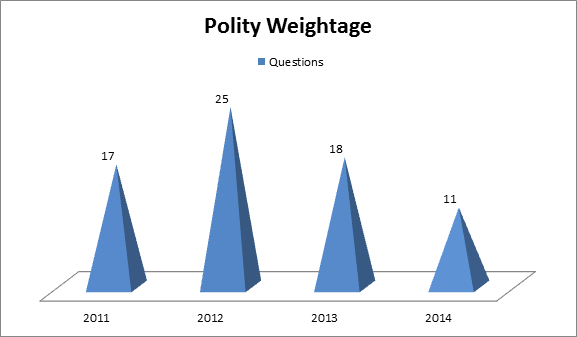
Weightage given to Indian Polity (since 2011)
So on an average 15%-18% of the questions come from Indian Polity. Because of the significance of weightage given in the exam, Polity as a subject becomes even more important in the preparation process.
How to Prepare
Polity is an important topic at all the three stages of exam, be it Prelims, Mains or Interview. The significance of the subject is carried forward, even when you get into the service. It forms an important part of administration. The topics under Polity range from –
Everything about Constitution, individual’s rights, duties and responsibilities to structure, power, functions and responsibilities of various institutions of administration. It also discusses about various policies of the Government, rights-based issues of the vulnerable groups.
So, one has to be abreast with the local happenings in and around you. A sense of awareness is created in the mind of the common man – about one’s rights, duties, responsibilities and help him/her to take an informed decision. It also helps in holding the Government accountable for failing to serve its people.
This is what makes Polity interesting and enjoyable. Henceforth, we recommend Polity to be read, not only as a civil service aspirant, but every Indian !!
Now, coming to the exam scenario
Questions from Polity cover both static (basic) as well as the dynamic (current events) part. For example in 2014, Judicial Appointment Bill was in news very frequently.
So, one must know the basics of Judiciary – its mode of appointment, powers and its autonomy granted by the Constitution of India.’ Issue’ related to Judiciary’s autonomy comes under the dynamic part whereas the mode of appointment and powers of Judiciary comes under the static part.
This is the best way to go about reading Polity. If you can read this way, then many myths about Polity (like mugging-up all the articles, everything and anything about Constitution) can be dealt with easily.
In 2014, two questions had come from Judiciary, based on the current issues. These were of static nature-
| The power to increase the number of judges in the Supreme Court of India is vested in
a) The President of India
b) The Parliament
c) The Chief Justice of India
d) The Law Commission
Solution (b)
|
| The power of the Supreme Court of India to decide disputes between the Centre and the States falls under its
a) Advisory jurisdiction
b) Appellate jurisdiction.
c) Original jurisdiction
d) Writ jurisdiction
Solution (c)
|
Similarly when Comptroller and Auditor General (CAG) was in news (in 2012) with regard to exposing 2G Scam and Coal Scam), one has to go back to basics (static part) in understanding the powers and functions of CAG, mode of appointment and removal. Current events should always be prepared along with its basics.
For example:
In India, other than ensuring that public funds are used efficiently and for intended purpose, what is the importance of the office of the Comptroller and Auditor General (CAG)?(2012)
1. CAG exercises exchequer control on behalf of the Parliament when the President of India declares national emergency/financial emergency.
2. CAG reports on the execution of projects or programmes by the ministries are discussed by the Public Accounts Committee.
3. Information from CAG reports can be used by investigating agencies to press charges against those who have violated the law while managing public finances.
4. While dealing with the audit and accounting of government companies, CAG has certain judicial powers for prosecuting those who violate the law.
Which of the statements given above is/are correct?
(a) 1, 3 and 4 only
(b) 2 only
(c) 2 and 3 only
(d) 1, 2, 3 and 4
Solution (c)
|
Current events related to new Bills, Acts, Policies and related provisions should be noted down. One should try to relate current happenings with provisions of Indian Constitution.
For example
| The National Green Tribunal Act, 2010 was enacted in consonance with which of the following provisions of the Constitution of India?(2012)
1. Right to healthy environment, construed as a part of Right to life under Article21
2. Provision of grants for raising the level of administration in the Scheduled Areas for the welfare of Scheduled Tribes under Article 275(1)
3. Powers and functions of Gram Sabha as mentioned under Article 243(A)
Select the correct answer using the codes given below:
(a) 1 only
(b) 2 and 3 only
(c) 1 and 3 only
(d) 1, 2 and 3
Solution (a)
|
Polity is the easiest of all the subjects to score, because of the following reasons:
- The syllabus is concise and factual
- Straight forward questions are asked (not much analytical) and if you have revised Polity thoroughly then, you can get most of the answers right if not for 100% accuracy
- The questions are generally easy to moderate
- Not many Books to read apart from the two omnipresent and most referred books of Polity – By DD Basu and Laxmikanth)
Note: ‘Indian Polity by M. Laxmikant’ alone can fetch you close to 100% marks in Polity section in the Prelims stage. This is based on the experience of all the Toppers. The language used is lucid and very easy to understand, even for a beginner who is reading Polity for the first time. However, because of its factual nature, one must revise more.
You can read ‘Introduction to the Constitution of India by D.D.Basu’ (if you still have time and patience J) after you have finished reading Laxmikant. This book is important from the MAINS perspective and gives you an in-depth analysis of the subject. The language of the book is quite complex with legal terms, and hence it will be difficult to understand for anyone who is studying Indian Polity for the first time.
Note: However, questions at times are tricky, as the options given in the questions are very close to the correct choice. This creates ambiguity in the mind of the aspirant often leaving them confused.
For example:
| Which of the following are associated with ‘Planning’ in India? (2013)
1. The Finance Commission
2. The National Development Council
3. The Union Ministry of Rural Development
4. The Union Ministry of Urban Development
5. The Parliament
Select the correct answer using the code given below.
A. 1, 2 and 5 only
B. 1, 3 and 4 only
C. 2 and 5 Only
D. 1, 2, 3, 4 and 5
Solution (c)
|
Here, though Finance Commission is involved in devolution of money it is not involved in Planning process. Many would have chosen (a) as the answer. Neither are the Ministries of Rural or Urban Development involved.
|
‘Economic Justice’ the objectives of Constitution has been as one of the Indian provided in: (2013)
(a) the Preamble and Fundamental Rights
(b) the Preamble and the Directive Principles of State Policy
(c) the Fundamental Rights and the Directive Principles of State Policy
(d) None of the above
Solution (b)
|
Prima-facie all the options look similar and may lead to confusion.
So, one should be more focused and attentive while attempting these questions. Having clarity in the powers and functioning of various institutions of administration and provisions of the Constitution, is very important. This comes by revising and regular practice of the MCQ’s (Multiple choice Questions). This will not only strengthen your basic concepts/understanding of the subject, but will also boost your confidence. Going through previous year Prelims Question papers and solving them will help you in understanding the nature of questions and prepare accordingly.
Common Myths about polity
Do I have to remember the entire list of Articles from 1 to 395?
No, you don’t have to. Try to understand the basics, when you revise it many a times, it will automatically be ingrained in your memory. Trust us J it is based on our own personal experiences. And also you don’t have to remember all the 450 articles. Only a few important articles like Article 72, 110, 249, 266, 267, 312 etc are important.
Indian Polity and Governance
Constitution – Historical Background, Making of the Constitution, Philosophy of the Constitution
Focus:
- Historical background – various Acts passed from Regulation Act, 1773 to Indian Independence Act, 1947’.
- Give more importance to Acts – post 1857, when British Crown assumed sovereignty over India from the East India Company.
- Be aware of at least two-three major provisions of an Act, and how did it help in creating a basic framework for the governance or administration during the British rule.
Example:
- Indian-Councils Act, 1909 – For the first time direct election was introduced; It provided for a separate electorate for the Muslims
- Making of the Constitution – Context in which the Constituent Assembly was framed.
- Role of Cripps Mission in the making of the Constitution
- Composition and role of the Constituent Assembly and its criticism
- Salient Features of the Constitution
- Schedules and Sources from where it has been borrowed
- Philosophy of the Constitution – The Preamble -its importance and utility; Understand the objective of the Preamble along with the key words like Sovereignty, Socialist, Secular, Justice etc.
Example (2012 Prelims Questions Paper):
| The distribution of powers between the Centre and the States in the Indian Constitution is based on the scheme provided in the(a) Morley-Minto Reforms, 1909(b) Montagu-Chelmsford Act, 1919
(c) Government of India Act, 1935
(d) Indian Independence Act, 1947
Solution (c)
|
Example (2013 Prelims Questions Paper):
| ‘Economic Justice’ the objectives of Constitution has been as one of the Indian provided in:(a) the Preamble and Fundamental Rights
(b) the Preamble and the Directive Principles of State Policy
(c) the Fundamental Rights and the Directive Principles of State Policy
(d) None of the above
Solution (b)
|
Example (2014 Prelims Questions Paper):
| Consider the following statements : A Constitutional Government is one which1. Places effective restrictions on individual liberty in the interest of State Authority
2. Places effective restrictions on the Authority of the State in the interest of individual liberty
Which of the statements given above is / are correct?
A. 1 only
B. 2 only.
C. Both 1 and 2
D. Neither 1 nor 2
Solution (b)
|
| Which one of the following Schedules of the Constitution of India contains provisions regarding anti-defection?A. Second Schedule
B. Fifth Schedule
C. Eighth Schedule
D. Tenth Schedule
Solution (d)
|
Union and its Territory
Focus:
- Article 1, Article 2, Article 3 and Article 4 – how article 2 is different from Article 3?
- Understand the expression ‘Union of India’, how its different from the ‘Territory of the India’
- Parliament’s power to reorganize State.
- Different Commissions set-up for Reorganization of States – DHAR commission and JVP commission, Fazal Ali commission
Note: You don’t have to remember formation of each State. Just remember the 1st State which was formed based on the Fazal Ali Commission and the recently formed State- Telangana
Citizenship
Focus:
- Constitutional Rights and Privileges of Citizens of India
- Acquisition and termination of citizenship
- Difference between a PIO, NRI, OCI
- Any recent policies and schemes related to PIO,NRI or OCI
- For example, Visa on Arrival Scheme
Note: Make note on the recent changes made regarding Citizenship, voting rights. Pre- Independence provisions can be skipped
Fundamental Rights (FR) [ Part III ]and Fundamental Duties[ Part IV-A ]
Focus
Fundamental Rights-
- Its significance implications and applications are important, than just remembering all the articles. Have a broader understanding of classification of Fundamental Rights and to which section of people are they targeted.
- Example: Article 29, 30, 31 – protects the Cultural and Educational Rights of Minorities.
- FR available to citizens of India only and both to citizens and foreigners
- Difference between Fundamental rights and Rights secured by other provisions of the Constitution like Writs
- Different types of Writs (Article 32) and its scope
- Present position of Right to Property
- Exceptional cases with regard to FR’s – Armed forces and when Martial Law is enforced
Fundamental Duties–
- Committee recommendations like Swaran Singh, Verma Committee
- General awareness on list of FD’s
- Enforcement of FD’s – is it justiciable or non-justiciable
- Significance and Criticism of FD’s
Example (2011 Prelims Questions Paper):
| In India, if a religious sect/community is given “the status of a national minority, what special advantages it is entitled to?1. It can establish and administer exclusive educational institutions.2. The President of India automatically nominates a representative of the community to LokSabha.
3. It can derive benefits from the Prime Minister’s 15-Point Programme.
Which of the statements given above is/are correct?(a) 1 only
(b) 2 and 3 only’
(c) 1 and 3 only
(d) 1, 2 and 3
Solution (c)
|
| Under the Constitution of India, which one of the following is not a fundamental duty?(a) To vote in public elections(b) To develop the scientific temper
(c) To safeguard public property
(d) To abide by me Constitution and respect its ideals
Solution (a)
|
Example (2012 Prelims Questions Paper
| Which of the following is/are among the Fundamental Duties of citizens laid down in the Indian Constitution?1. To preserve the rich heritage of our composite culture2. To protect the weaker sections from social injustice
3. To develop the scientific temper and spirit of inquiry
4. To strive towards excellence in all spheres of individual and collective activity
Select the correct answer using the codes given below :
(a) 1 and 2 only
(b) 2 only
(c) 1, 3 and 4 only
(d) 1, 2, 3 and 4
Solution (c)
|
Directive Principles of State Policy (DPSP) [ Part IV ]
Focus:
- Classification of DPSP- Socialistic, Gandhian, Liberal-Intellectual principles
- Its significance & Principle- like socio-economic aspect
- Justifiable or not- enforceable in court or not
- Comparison between DPSP and Fundamental Rights,
- Conflicts between them – Chronology of cases from Champalam Dorairajan case (1951) to Minerva Mills case (1980) and the present position of FR’s w.r.t DPSP
- Significance of 42nd and 44th Amendment Act w.r.t DPSP
Note: Give special importance to Golaknath Case, Keshavananda Bharthi, Minerva Mills, Maneka Gandhi case, Berubari Union, 3 Judges case.
Example (2013 Prelims Questions Paper):
| According to the Constitution of India, which of the following are fundamental for the governance of the country?(a) Fundamental Rights(b) Fundamental Duties
(c) Directive Principles of State Policy
(d) Fundamental Rights and Fundamental Duties
Solution (c)
|
Example (2014 Prelims Questions Paper):
| In the Constitution of India, promotion of international peace and security is included in theA. Preamble to the ConstitutionB. Directive Principles of State Policy (DPSP)
C. Fundamental Duties
D. Ninth Schedule
Solution (b)
|
Amendment of the Constitution
Focus
- Procedure for amendment based on Simple and Special majority (Article 368); provisions of the Constitution which can be amended based on Simple and Special majority.
- Amendability of Fundamenta Rights
- What constitutes ‘Basic Structure’ like Supremacy of the Constitution, Judicial Review, Secular character etc.
- Important Constitutional Amendments Acts – 42nd, 44th , 61st 72nd, 73rd
- Criticism
Note: Note down the recent amendments from 91st Amendment Act, 2003 till date.
Example (2013 Prelims Questions Paper):
| Consider the following statements1. An amendment to the Constitution of India can be initiated by an introduction of a bill in the LokSabha only.2. If such an amendment seeks to make changes in the federal character of the Constitution, the amendment also requires to be ratified by the legislature of all the States of India.
Which of the statements given above is/are correct?
(a) 1 only
(b) 2 only
(c) Both 1 and 2
(d) Neither 1 nor 2
Solution (d)
|
Union Government
- A general understanding on the difference between Prime Ministerial and Presidential form of Government, its merits and de-merits.
Union Executive
President, Vice-President, Prime Minister, Central Council of Ministers
The executive institutions should be studied on with the following points in
Focus:
- Election procedure/Mode of Appointment
- Powers and Functions Example: Veto power, Ordinance making power, Pardoning power (article 72) of the president
- Resignation/Removal/Impeachment
- Relationship between President and Prime-Minister with regard to their roles and responsibilities
Note: Be aware of the recent issues w.r.t to Pardoning power (as was in the case of Ajmal Kasab, Afzal Guru), Impeachment, Ordinance-making Power of the President
Central Council of Ministers (COM)
- Importance of 91st Amendment Act with regard to composition of COM
- Difference between COM’s and Cabinet Ministers
- Cabinet ministers, Cabinet Committees – their role and responsibilities
- Understand the concept of collective responsibility, kitchen cabinet
Example (2012 Prelims Questions Paper):
| The Prime Minister of India, at the time of his/her appointment: (2012)(a) need not necessarily be a member of one of the Houses of the Parliament but must become a member of one of the” Houses within six months(b) need not necessarily be a member of one of the Houses of the Parliament but must become a member of the LokSabha within six months
(c) must be a member of one of the Houses of the Parliament
(d) must be a member of the LokSabha
Solution (a)
|
Example (2013 Prelims Questions Paper):
| Consider the following statements:1. The Council of Ministers in the Centre shall be collectively responsible to the Parliament.2. The Union Ministers shall hold the office during the pleasure of the President of India.
3. The Prime Minister shall communicate to the President about the proposals for legislation.
Which of the Statements given above is/are correct?
(a) 1 only
(b) 2 and 3 only
(c) 1 and 3 only
(d) 1,2 and 3
Solution (b)
|
Example (2014 Prelims Questions Paper):
| Consider the following statements:1. The President shall make rules for the more convenient transaction of the business of the Government of India, and for the allocation among Ministers of the said business.2. All executive actions of the Government of India shall be expressed to be taken in the name of the Prime Minister.
Which of the statements given above is / are correct?
A. 1 Only
B. 2 only
C. Both 1 and 2
D. Neither 1 nor 2
Solution (a)
|
Union Legislature – Parliament
Atleast 25-30% (out of total questions in Polity) of the marks come from this chapter and is the most important topic from the exam’s perspective. The entire chapter is important!
Focus:
- Working of the Parliament-
- Role and functions of the Parliament
- Sessions, Motions, Parliamentary procedure – Summoning, Prorogation, Joint sitting
- Devices of Parliamentary proceedings like Question Hour, Zero Hour, Adjournment Motion etc.
- Similarities and Differences between Lok Sabha, Rajya Sabha, their composition, election, powers and functions; Special powers of Rajya Sabha
- Qualifications and Disqualification’s of members; Anti defection law
- Parliamentary Privileges
- Enactment/Procedure to make Law-
- Different stages in passing of a Bill
- Different types of bills – Ordinary Bill, Money Bill, Finance Bill –its importance
- Budget-
- Enactment of Budget
- What does the budget contain? Its significance
- What do you understand by Charged Expenditure?
- Funds available like Consolidated Fund, Contingency Fund, Public Accounts Fund- who authorizes it, what does it contain?
- Role of important institutions in the Parliament like Speaker and Chairman of RajyaSabha – their election, removal/resignation, functions
- Role of Leader of opposition (LoP)
- Importance of Parliamentary Committees –Estimates Committee, Business Advisory Committee, Committee on Government Assurance – their composition, functions, and a general idea about the less significant committees like Rules Committee etc.
Example (2011 Prelims Questions Paper):
| What is the difference between “vote-on-account” and “interim budget”?(2011)1. The provision of a “vote-on-account” is used by a regular Government, while an “interim budget” is a provision used by a caretaker Government.2. A “vote-on-account” only deals with the expenditure in Government’s budget, while an “interim budget” includes both expenditure and receipts.
Which of the statements; given above is/are correct?
(a) 1 only
(b) 2 only
(c) Both 1 and 2
(d) Neither 1 nor 2
Solution (b)
|
Example (2014 Prelims Questions Paper):
| Which one of the following is the largest Committee of the Parliament?A. The Committee on Public AccountsB. The Committee on Estimates
C. The Committee on Public Undertakings
D. The Committee on Petitions
Solution (b)
|
| Consider the following statements regarding a No-Confidence Motion in India:1. There is no mention of a No-Confidence Motion in the Constitution of India.2. A Motion of No-Confidence can be introduced in the Lok Sabha only.
Which of the statements given above is / are correct?
A. 1 only
B. 2 only
C. Both 1 and 2
D. Neither 1 nor 2
Answer: (c)
|
State Government- State Executive and State Legislature
Note: Once you have completed reading ‘Union Government’ then going through topics under ‘State Government’ becomes easier. Due to similarities of the two topics, the time spent will also be less.
The next question would be what to focus in the State Government chapter?
Focus:
- On the ‘differences’ between the different institutions like Governor, Chief Minister, State Legislature, High Court w.r.t the Centre Government (like President, Prime Minister, Parliament, Supreme Court). Example:
- In the topic ‘ Governor focus on
- The controversial nature in the ‘Appointment of Governor’
- Constitutional position of Governor
- The Governor’s Legislative functions, Judicial functions and Discretionary powers (as they slightly differ from the President’s functions)
- Similarly, in the topic ‘State Legislature’ focus on:
- Differences in State legislature compared to the Parliament with regard to composition, powers, functions.
- States which have Bi-cameral legislatures (Example: BIMAKUJ only these six states have Bi-cameral legislatures)
- Creation and abolition of the Upper House (or the legislative council)- Article 169
- Position of legislative council w.r.t the Legislative Assembly and Rajya Sabha
Note: The Union and the State Government is a dynamic topic, which needs to be inter-linked with the current happenings/events. Hence, Newspaper reading is a must and should !
Administration of Union Territories (UT)
Focus:
- Reasons behind the creation of UT
- Powers of President and Governor w.r.t administration of UT
- Administrative System of Union Territories like -who is the Executive Head, which UT’s have Legislative Assembly, under the jurisdiction of which High Court does it come.
- Special provisions for Delhi
Note: Have a basic understanding of Special provisions w.r.t Jammu and Kashmir (Article 370) and its provisions; Compare it with Article 371-J; Difference between article 370 & 371.
Example (2014 Prelims Questions Paper):
| Which of the following are the discretionary powers given to the Governor of a State?
1. Sending a report to the President of India for imposing the President’s rule
2. Appointing the Ministers
3. Reserving certain bills passed by the State Legislature for consideration of the President of India
4. Making the rules to conduct the business of the State Government
Select the correct answer using the code given below.
A. 1 and 2 only
B. 1 and 3 Only
C. 2, 3 and 4 only.
D. 1, 2, 3 and 4
Solution (b)
|
Example (2013 Prelims Questions Paper):
| Which one of the following statements is correct?
(a) In India, the same person cannot be appointed as Governor for two or more States at the same time
(b) The Judges of the High Court of the States in India are appointed by the Governor of the State just as the Judges of the Supreme Court are appointed by the President
(c) No procedure has been laid down in the Constitution of India for the removal of a Governor from his/her post
(d) In the case of a Union Territory having a legislative setup, the Chief Minister is appointed by the Lt. Governor on the basis of majority support.
Solution (c)
|
Administration of Special Areas
Focus:
- Significance and differences between 5th Schedule(Scheduled Areas) and 6th Schedule (Tribal Areas)
- Powers of President and Governor w.r.t administration of Scheduled Areas and Tribal Areas
Federal System
Focus:
- Comparison between Unitary and Federal features; advantages and disadvantages
- Distribution of legislative, Executive and Financial Powers between the Union and the State Government
- Legislative – The Union list, State List and the Concurrent list; Residuary powers
- Principles underlying distribution of Tax revenues
- Circumstances under which Parliament can legislate in the State field like when Rajya Sabha passes a resolution (A-249), during national emergency (A-352) etc.
- Finance – Role of Finance Commission (Statutory grants) and Planning Commission (Discretionary grants)
- Issues with the above two institutions – FC and PC
- Borrowing powers of the Union and the States from Market and Abroad
- Executive – in giving directions to the State Government
- All-India Services, UPSC
- Extra-Constitutional devices like Planning Commission, National Development Council, National integration Council etc.
Very Important:
Federal System too is a very dynamic topic, which needs to be inter-linked with the current happenings/events. There are lot tension areas between the Centre and the State which needs a balanced outlook.
For example: issues range from formation of New States, Niti Ayog replacing Planning Commission, GST, river water disputes, PC and FC, role of Governor. This should be supplemented with Committee recommendations like Sarkaria Committee, Punchhi Committee, Administrative Reforms Committee .
Example (2013 Prelims Questions Paper):
| The Parliament can make any law for whole or any part of India for implementing international treaties
(a) with the consent of all the States
(b) with the consent of the majority of States
(c) with the consent of the States concerned
(d) without the consent of any State
Solution (d)
|
Inter-State Relations
Focus:
For coordination between States, the Constitution has provided for Inter-State Comity which consists of:
- Full Faith and Credit clause
- Inter-state River water dispute (A-262)
- Inter-state council (A-263)- composition, functions
- Zonal council- composition, functions
- Freedom of Inter-State trade and Commerce
- Freedom of Movement and residence throughout the country (Article 19(1)(d) and (e))
Emergency Provisions
Focus
- Different kinds of Emergency- National (A-352), President’s rule(A-356) and Financial emergency (A- 360)
- Changes brought about by 42nd and 44th Amendment Act w.r.t Emergency
- Procedure and Time duration for approval, renewal and revocation of emergency and who is authorized to declare and revoke emergency
- Example: The President can declare National Emergency, which has to be approved by both the Houses within 1 month by Special Majority; the emergency can continue for indefinite period with periodical approval every 6 months; Only LokSabha with a Simple majority can disapprove the national emergency.
- Impact on distribution of legislative, Executive and Financial Powers when Emergency is in force
- Effect on Fundamental Rights during emergency (Article 358 and Article 359)
- Criticism/misuse of emergency powers by the Central Government
Note: Financial emergency not so important. Not even once has it been declared.
Judiciary
Focus:
- Supreme Court– Appointment of judges, Procedure for removal of judges
- Constitutional provisions to safeguard the Independence of Supreme Court
- Jurisdictions and Powers of Supreme Court – Writ jurisdiction, Appellate jurisdiction, Original jurisdiction, Special leave petition, Advising jurisdiction
- Power of judicial review
- High Court– Differences between High Court and Supreme Court with regard to their powers, jurisdiction; Removal of a HC judge
- Subordinate Courts – Understand the Organization of the Subordinate Courts
Note: Supreme Court and High Courts judgments, verdicts and directions are always in news. This topic too is dynamic – be it with the recently approved National Judicial Appointment Committee (NJAC) or appointment of Special Investigation Team (SIT) on ‘Black money’ or recent verdicts on Capital punishment
Example (2012 Prelims Questions Paper):
| Which of the following are included in the original jurisdiction of the Supreme Court?
1. A dispute between the Government of India and one or more States
2. A dispute regarding elections to either House of the Parliament or that of Legislature of a State
3. A dispute between the Government of India and a Union Territory
4. A dispute between two or more States
Select the correct answer using the codes given below :
(a) 1 and 2
(b) 2 and 3
(c) 1 and 4
(d) 3 and 4
Solution (c)
|
Constitution Bodies
Focus
- Election Commission, UPSC, SPSC, Finance Commission, National Commission for SCs and ST’s, Special officer for Linguistic Minorities, Comptroller and Auditor General of India (CAG), Attorney General and Solicitor General, Advocate General of the State
- Focus on Composition, Powers and functions, Removal of the Constitutional bodies
Example (2011 Prelims Questions Paper):
| With reference to the Finance Commission of India, which of the following statements is correct?
(a) It encourages the inflow of foreign capital for infrastructure development
(b) It facilitates the proper distribution of finances among the Public Sector Undertakings
(c) It ensures transparency in financial administration
(d) None of the statements (a), (b) and (c) given above is correct in this context
Solution (d)
|
Example (2012 Prelims Questions Paper):
| In India, other than ensuring that public funds are used efficiently and for intended purpose, what is the importance of the office of the Comptroller and Auditor General (CAG)?
1) CAG exercises exchequer control on behalf of the Parliament when the President of India declares national emergency/financial emergency.
2) CAG reports on the execution of projects or programmes by the ministries are discussed by the Public Accounts Committee.
3) Information from CAG reports can be used by investigating agencies to press charges against those who have violated the law while managing public finances.
4) While dealing with the audit and accounting of government companies, CAG has certain judicial powers for prosecuting those who violate the law.
Which of the statements given above is/are correct?
(a) 1, 3 and 4 only
(b) 2 only
(c) 2 and 3 only
(d) 1, 2, 3 and 4
Solution (c)
|
| With reference to the Delimitation Commission, consider the following statements :
1. The orders of the Delimitation Commission cannot be challenged in a Court of Law.
2. When the orders of the Delimitation Commission are laid before the LokSabha or State Legislative Assembly, they cannot effect any modifications in the orders.
Which of the statements given above is/are correct?
(a) 1 only
(b) 2 only
(c) Both 1 and 2
(d) Neither 1 nor 2
Solution (c)
|
Example (2013 Prelims Questions Paper):
| Consider the following statements; Attorney General of India can
1. take part in the proceedings of the LokSabha
2. be a member of a committee of the LokSabha
3. speak in the LokSabha4. vote in the LokSabha
Which of the statements given above is/are correct?
(a) 1 only
(b) 2 and 4
(c) 1, 2 and 3
(d) 1 and 3 only
Solution (c)
|
Non-Constitutional Bodies
Focus
- Planning Commission, National Development Council, National Human Rights Commission, State Human Rights Commission, Central Information Commission, State Information Commission, Central Vigilance Commission ,Central Bureau of Investigation, Lokpal and Lokayuktas
- Focus on Composition, Functions, Working of the Non-Constitutional bodies
Example (2013 Prelims Questions Paper):
| Which of the following bodies does not/do not find mention in the Constitution?
1. National Development Council
2. Planning Commission
3. Zonal Councils
Select the correct answer using the codes given below.
(a) 1 and 2 only
(b) 2 only
(c) 1 and 3 only
(d) 1, 2 and 3
Solution (d)
|
| Who among the following constitute the National Development Council?
1. The Prime Minister
2. The Chairman, Finance Commission
3. Ministers of the Union Cabinet
4. Chief Ministers of the States
Select the correct answer using the codes given below:
(a) 1, 2 and 3 only
(b) 1, 3 and 4 only
(c) 2 and 4 only
(d) 1, 2, 3 and 4
Solution (b)
|
Tribunals
Focus:
- Establishment of the Tribunal, appointment of the Chairman
- Tribunals under Article 323A and Tribunals under Article 323B
- Functions and Powers of Administrative Tribunals – Central Administrative Tribunal (CAT) and State Administrative Tribunal (SAT)
Special Provisions for SC’s, ST’s, Backward Classes, Minorities and Anglo-Indians
- A basic idea – on the Constitutional provisions for SC’s, ST’s, Backward Classes, Minorities and Anglo-Indians.
Panchayati Raj
Focus:
Decentralisation- steps taken by the government in this regard, people participation,
- Important Acts related to Panchayat Raj system like 73rd Amendment Act, 74th Amendment Act, Panchayats (Extension to Scheduled Areas) Act, 1996 or PESA , Forest Rights Act etc.
- Evolution & recommendations of committees
- Provisions of 73rd amendment- Compulsory and Voluntary
- Provisions of 74th amendment – structure, powers, functions
- Types of urban government
- Metropolitan planning committee (MPC)
- Problems faced by Panchayat Raj institutions and Urban Local Governments
Example (2011 Prelims Questions Paper):
| Consider the following statements: In India, a Metropolitan Planning Committee
1. is constituted under the provisions of the Constitution of India.
2. prepares the draft development plans for metropolitan area.
3. has the sole responsibility for implementing Government sponsored schemes in the metropolitan area.
Which of the statements given above is/are correct?
(a) 1 and 2 only
(b) 2 only
(c) 1 and 3 only
(d) 1, 2 and 3
Solution (a)
|
Example (2012 Prelims Questions Paper):
| How do District Rural Development Agencies (DRDAs) help in the reduction of rural poverty in India?
1. DRDAs act as Panchayati Raj Institutions in certain specified backward regions of the country.
2. DRDAs undertake area-specific scientific study of the causes of poverty and malnutrition and prepare detailed remedial measures.
3. DRDAs secure inter-sectoral and inter-departmental coordination and cooperation for effective implementation of anti-poverty programmes.
4. DRDAs watch over and ensure effective utilization of the funds intended for anti-poverty programmes.
Which of the statements given above is/are correct?
(a) 1, 2 and 3 only
(b) 3 and 4 only
(c) 4 only
(d) 1, 2, 3 and 4
Solution (b)
|
Governance and Public Policy
Focus:
- This section includes important schemes, programmes, missions, laws and policies launched by the government.
- It also includes ‘recent’ Government Bills. One must be aware of all the major schemes launched by the government, especially the recently launched schemes/policies etc.
- Governance- actions, measures, or steps taken by the Government (Ex: Inclusive governance) for growth & development
Example (2012 Prelims Questions Paper):
| If National Water Mission is properly and completely implemented, how will it impact the country?
1. Part of the water needs of urban areas will be met through recycling of wastewater.
2. The water requirements of coastal cities with inadequate alternative sources of water will be met by adopting appropriate technologies that allow for the use of ocean water.
3. All the rivers of Himalayan origin will be linked to the rivers of peninsular India,
4. The expenses incurred by farmers for digging bore-wells and for installing motors and pump-sets to draw groundwater will be completely reimbursed by the Government.
Select the correct answer using the codes given below:
(a) 1 only
(b) 1 and 2 only
(c) 3 and 4 only
(d) 1, 2, 3 and 4
Solution (b)
|
| Which of the following can be said to be essentially the parts of Inclusive Governance?
1. Permitting the Non-Banking Financial Companies to do banking
2. Establishing effective District Planning Committees in all the districts
3.Increasing the government spending on public health
4. Strengthening the Mid-day Meal Scheme
Select the correct answer using the codes given below:
(a)1 and 2 only
(b) 3 and 4 only
(c) 2, 3 and 4 only
(d) 1, 2, 3 and 4
Solution (c)
|
Rights Issue
- The scope of this section includes rights of vulnerable communities in India like women, children, disabled, SCs, STs and OBCs, consumer rights and Acts like Right to Information Act. Constitutional Bodies like NHRC etc.
- Source: Newspaper, http://pib.nic.in/, http://prsindia.com/, Yojana and Kurukshera Magazines, Websites of Ministries and ‘India Yearbook’ published by the Publication Division, Ministry of Information and Broadcasting
Note: ‘Public Policy’ & ‘Rights Issue’ overlaps with ‘Social Sector initiatives’ of the Government under Economics section. So we have covered all the social sector initiatives under these two sections only.
Example (2011 Prelims Questions Paper
|
India is home to lakhs of persons with disabilities. What are the benefits available to them under me law?
1. Free schooling till the age of 18 years in government-run schools.
2. Preferential allotment of land for getting up business.
3. Ramps in public buildings.
Which of the statements given above is/are correct?
(a) 1 only
(b) 2 and 3 only
(c) 1 and 3 only
(d) 1, 2 and 3
Solution (d)
|
Example (2012 Prelims Questions Paper)
|
With reference to consumers’ rights/ privileges under the provisions of law in India, which of the following statements is/are correct?
1. Consumers are empowered to take samples for food testing.
2. When a consumer files a complaint in any consumer forum, no fee is required to be paid.
3. In case of death of a consumer, his/her legal heir can file a complaint in the consumer forum on his/her behalf.
Select the correct answer using the codes given below:
(a) 1 only
(b) 2 and 3 only
(c) 1 and 3 only
(d) 1, 2 and 3
Solution (c)
|
Sources to Prepare
- Lakshmikant- Indian Polity- Highly recommended
- NCERT- Class 9th to 12th

No comments :
Post a Comment