HISTORY STRATEGY
1. Weightage Given to History
2. Modern History
> Weightage Given
> How to prepare
> Previous Year UPSC Questions and Solutions from Modern History
3. Ancient History
> Weightage Given
> How to prepare
> Previous Year UPSC Questions and Solutions from Ancient History
4. Medieval History
> Weightage Given
> How to prepare
> Previous Year UPSC Questions and Solutions from Medieval History
2. Modern History
> Weightage Given
> How to prepare
> Previous Year UPSC Questions and Solutions from Modern History
3. Ancient History
> Weightage Given
> How to prepare
> Previous Year UPSC Questions and Solutions from Ancient History
4. Medieval History
> Weightage Given
> How to prepare
> Previous Year UPSC Questions and Solutions from Medieval History
INDIAN HISTORY AND INDIAN NATIONAL MOVEMENT
History of India can be divided into 3 sections – Ancient, Medieval and Modern. A significant weightage has been given to History over the years.
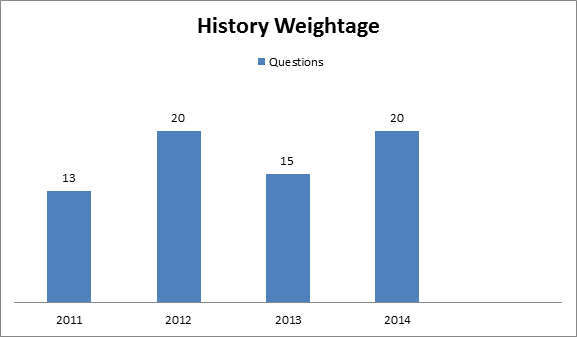
As per the recent trend, atleast 15-20% weightage is given to History.
But then History is a very ‘vast’ subject. So what to do now? A plethora of questions keep bombarding your head – How do I read History? What to focus on? Will I be able to cover the entire syllabus?
The answer to all your confusion is here – You have to think smart! From the previous year papers analysis, we have observed that more weightage is given to ‘Modern History’. So to make the maximum benefit for the time invested, ‘prioritize’ in this order- Modern, Ancient and Medieval History.
In this article, to ease your preparation we have divided History into 4 Sections – Modern, Ancient, Medieval and Culture. Under each section we have analysed the weightage given, what aspects to focus on and the books to refer.
Since, Culture too has been gaining a lot of mileage in the recent times, we have come up with aseparate section for Culture (In 2014 alone, 7 questions had come from this section)
So now let’s start with Modern History.
- MODERN INDIA
Emergence of regional powers in the early decades of 18th Century is taken as a change from the Medieval to Modern India.
The early modern India witnessed the fall of the great Mughal Empire, the Marathas and Consolidation of British rule in India. The mid-phase marks the struggle of Indians- revolt of 1857 (or the First War of Independence), organisation of Indian National Congress, role of Moderates and the Extremists. And finally the last stage stands testimony to various National Movements –Civil Disobedience Movements, Quit India Movement, Formation of Constitution Assembly and Sampoorna Swaraj (or Complete Independence) to India.
Modern India is the most important section from the prelims perspective. The weightage given to this section over the years stands testimony to the significance of this section.
Weightage given since 2011
| YEAR | MARKS |
| 2011 | 9 |
| 2012 | 8 |
| 2013 | 6 |
| 2014 | 5 |
How to read Modern History?
- In this section, we come across various revolts/movements/agitations (like 1857 revolt, Tebhaga Peasant Movement, Home Rule Movement, Quit India Movement).
What one needs to Focus here is:
- The Purpose of the movement[s]
- The Reasons which led to the movement[s]
- The Consequences of the movement[s]
- The people who participated in this movement[s]
- Famous Personalities involved in the movement[s] and their contribution
- The role of Press and Literature
Note: Also note down the ‘chronology’ of the major Movements and Missions sent by the British to gain support of the Indians and extend their rule.
Example (2013 Prelims Questions Paper):
| Annie Besant was:
1. responsible for starting the Home Rule Movement
2. the founder of the Theo-sophical Society 3. once the President of the Indian National Congress
Select the correct statement/statements using the codes given below.
(a) 1 only
(b) 2 and 3 only
(c) 1 and 3 only
(d) 1, 2 and 3
Solution (c)
|
Type of Administration (Revenue, Military)
Focus:
- Type of Administration followed during The Mughal’s rule. Example: Mansabdari System, Jagirdhari – its significance and impact.
- The British rule. Example: Subsidiary alliance, Permanent Settlement, Mahalwari system etc. – its significance and impact.
- Similarities and Differences between the Mughal and the British Administration
- Consolidation of the British rule in India– through enactment of various Acts/Laws (Regulation Act, 1773 to Indian Independence Act, 1947).
Atleast two to three important changes/provisions made under each Act and the Governor Generals involved should be noted down. And also the impact of the Act should be given importance.
Example: Under Charter Act, 1833- The East Indian Company’s monopoly over tea and China was ended. Lord William Bentinck was the Governor General then and he was instrumental in abolition of ‘sati’ system.
Colonial Rule in India
Focus:
- Political-Administrative organization, Policies of the British India.
- Social, Economic setup like Agrarian Systems (Example: Permanent Settlement)
- Important Reports, Sessions, Acts, Committees setup during the British period
Note: Give special importance to Events, Movements (including Tribal, Peasant and Trade Union Movements) and Acts passed after Revolt of 1857.
Example (2011 Prelims Questions Paper):
The tendency for increased litigation was visible after the introduction of the land settlement system of Lord Cornwallis in 1793. The reason for this is normally traced to which of the following provisions?
(a.) Making Zamindar’s position stronger vis-a-vis the ryot
(b.)Making East India Company an overlord of Zamindars
(c.) Making judicial system more efficient
(d.)None of the (a), (b) and (c) above
Solution (d)
|
Example (2014 Prelims Questions Paper):
| What was/were the object/objects of Queen Victoria’s Proclamation (1858)? 1. To disclaim any intention to annex Indian States 2. To place the Indian administration under the British Crown 3. To regulate East India Company’s trade with IndiaSelect the correct answer using the code given below
(a) 1 and 2 only
(b) 2 only
(c) 1 and 3 only
(d) 1, 2 and 3
Solution (a)
|
Religious and Social Reform Movements (from 1800 AD to 1947 AD)
This is another important section of Indian National Movement from the Prelims point of view.
Focus:
- The Ideological base – rationalism, humanism and universalism
- Reform Movements like Brahmo Samaj, Arya Samaj, Theosophical Society, Harijan Movement etc.
- who started these movements
- what was the objective and emphasis of these movements
- how these movements were important in building a sense of nationalism among Indians.
- Social reforms that had an impact on Education, Status of Women, Caste system of the society.
Example (2012 Prelims Questions Paper):
| Which of the following statements is/are correct regarding BrahmoSamaj? 1. It opposed idolatry. 2. It denied the need for a priestly class for interpreting the religious texts. 3. It popularized the doctrine that the Vedas are infallible.Select the correct answer using the codes given below :
(a) 1 only
(b) 1 and 2 only
(c) 3 only
(d) 1, 2 and 3
Solution (b)
|
Famous Personalities (Mahatma Gandhi, Dr B.R. Ambedkar, Subash Chandra Bose, DadabhaiNaoroji, Bal Gangadhar Tilak, Bhagat Singh, Annie Besant etc)
Focus:
- Their contributions – literature, organization of movements and their role in India’s Freedom Struggle
Example (2012 Prelims Questions Paper):
Consider the following statements :
The most effective contribution made by DadabhaiNaoroji to the cause of Indian National Movement was that he
1. exposed the economic exploitation of India by the British
2. interpreted the ancient Indian texts and restored the self-confidence of Indians
3. stressed the need for eradication of all the social evils before anything elseWhich of the statements given above is/are correct?
The most effective contribution made by DadabhaiNaoroji to the cause of Indian National Movement was that he
1. exposed the economic exploitation of India by the British
2. interpreted the ancient Indian texts and restored the self-confidence of Indians
3. stressed the need for eradication of all the social evils before anything elseWhich of the statements given above is/are correct?
(a) 1 only
(b) 2 and 3 only
(c) 1 and 3 only
(d) 1, 2 and 3
(b) 2 and 3 only
(c) 1 and 3 only
(d) 1, 2 and 3
Solution (a)
-------------------------------------
ANCIENT HISTORY
Weightage given since 2011
| YEAR | MARKS |
| 2011 | 2 |
| 2012 | 6 |
| 2013 | 3 |
| 2014 | 5 |
How to study Ancient History?
The ancient History starts from the earliest time to the middle of 8th Century AD. This article tells you on how to read and what topics to focus on from Prelims perspective.
Prehistoric Period– Stone Age, Paleolithic Age, Mesolithic Age, Neolithic Age, Chalcolithic Age
Focus:
- On what basis is the Prehistoric period classified.
- The mode of living of people like hunting, domestication.
Indus Valley Civilization/ Harappan Civilization (2500 BC- 1500 BC)
Focus:
- The lifestyle of people during this period- Social, Economic (agriculture, trade and commerce), Religious and Cultural activities.
- Important Harappan sites and its significance. Example: Mohenjodaro, Harappa and others.
- Script and language used during IVC.
- Art and Crafts- seals, pottery etc.
- Why did the civilization decline?
Example (2011 Prelims Questions Paper):
Regarding the Indus Valley Civilization, consider the following statements:(2011)
1. It was predominantly a secular civilization and the religious element, though present, did not dominate the scene,
2. During this period, cotton was used for manufacturing textiles in India.
Which of the statements given above is/are correct?
(a.) 1 only
(b.) 2 only
(c.) Both 1 and 2
(d.) Neither 1 nor 2
Solution (c)
|
Vedic Period (1500 BC- 1000 BC)
Focus:
- Society (people and their lifestyle)- family, marriage, status of women, caste system or social divisions.
- Economic Life and Political Organisation.
- Culture and Religion
- Literature during Vedic times – Vedas, Upanishads, Dharma Shastras, Puranas and Six systems of Philosophy.
- Important Gods worshipped and their significance to Vedic people.
- Differences between Early and Later Vedic Society and life styles followed.
Note: Terms like Purohita, Jana or Kula- UPSC has started picking such terms and asking simple questions based on the term. You should be prepared not to miss these questions.
Example (2011 Prelims Questions Paper):
| Which of the following characterizes/ characterize the people of Indus Civilization? (2013)
1. They possessed great palaces and temples.
2. They worshipped both male and female deities.
3. They employed horse-drawn chariots in warfare.
Select the correct statement/ statements using the codes given below.
(a) 1 and 2 only
(b) 2 only
(e) 1, 2 and 3
(d) None of the statements given above is correct
Solution (b)
|
Buddhism and Jainism
Focus:
- Reasons for the growth of such religious movements
- Buddha and Mahavira -their Believes (in Nirvana, Law of Karma etc.),their Contributions, Teachings, Philosophy, Literature.
- Important Events during their Life (Enlightenment); Buddhist and Jaina Councils.
- Types of Bhuddhism – Hinayana, Mahayana and Vajrayana (their believes and differences among them)
- Two Sects of Jainism – Svetamabara and Digambara; Ajivikas
- Differences between Jainism and Buddhism
- Causes of Decline of Buddhism and Janism
Example (2011 Prelims Questions Paper):
| With reference to the history of ancient India, which of the following was/were common to both Buddhism and Jainism?(2012)
1. Avoidance of extremities of penance and enjoyment
2. Indifference to the authority of the Vedas
3. Denial of efficacy of rituals
Select the correct answer using the codes given below :
(a) 1 only
(b) 2 and 3 only
(c) 1 and 3 only
(d) 1, 2 and 3
Solution (b)
|
Kingdoms/Empires during the Ancient Period
During the Ancient times, we come across different Empires and Dynastic rule-
The Mauryan Empire, Guptas, Sunga, Kanva dynasties’, Satavahanas, Rastrakutas, Pallavas, Cholas, Cheras, Pandyas , Chalukyas.
While studying these Kingdoms, you have to Focus on the following aspects:
- The rise of the Empires – causes, impact.
- Important Rulers – ChandraGupta Maurya, Ashoka (Ashoka’s Dhamma, Edicts and important sites where they were found) and their contribution to the society, art and culture.
- The Economic and Social Conditions during the rule
- Art and Architecture
- Literature -Famous literary works – Kalidasa’s ‘Abhigyanashakuntalam’ etc.
- Development of Science and technology – Aryabhatta’s ‘Suryasiddhanta’ etc.
- The Decline of the empires – causes
- Foreign travellers and their works Example: Chinese traveler Fahein’s account of India during in the 5th
Note : Special importance should be given to Mauryan and Gupta’s time
Example (2012 Prelims Questions Paper):
With reference to the guilds (Shreni) of ancient India that played a very important role in the country’s economy, which of the following statements is /are correct?(2012)
1. Every guild was registered with the central authority of the State and the king was the chief administrative authority on them.
2. The wages, rules of work, standards and prices were fixed by the guild.
3. The guild had judicial powers over its own members.
Select the correct answer using the codes given below :
(a) 1 and 2 only
(b) 3 only
(c) 2 and 3 only
(d) 1, 2 and 3
Solution (d)
--------------------------------------------
MEDIEVAL HISTORY
The Medieval History begins from the middle of 8th Century AD to the start of 18th Century AD. Question’s from Medieval History is limited, unlike Ancient and Modern History. This is evident from the year on year analysis of the previous year Question-paper.
Weightage given since 2011
| YEAR | MARKS |
| 2011 | 1 |
| 2012 | 1 |
| 2013 | 2 |
| 2014 | 2 |
But then you never know, UPSC can spring out surprises. Many aspirants skip this section, but you can smartly Focus on certain topics and leave no stone unturned in your preparation.
How to Read Medieval History?
1. Religious movements
Focus:
- Sufi and Bhakti Movements and Saints(special importance to Women Saints) – their doctrines and practices
- revival of Hinduism (by Adi Sankaracharya)
- Impact of these movements.
Example (2012 Prelims Questions Paper):
| With reference to the religious history of medieval India, the Sufi mystics were known to pursue which of the following practices? 1. Meditation and control of breath 2. Severe ascetic exercises in a lonely place 3. Recitation of holy songs to arouse a state of ecstasy in their audienceSelect the correct answer using the codes given below :(a) 1 and 2 only (b) 2 and 3 only (c) 3 only (d) 1, 2 and 3
Solution (d)
|
2. Ruler’s/Empires (from Delhi Sultanates to Mughals)
(You don’t have to remember the name of the rulers, dates)
What you have to focus on is:
- Political, Social, Economic organization during different ruler’s- the Delhi Sultanates, Vijayanagar Empire and the Bahamani Kingdoms, Mughals etc.
- Art and Architecture during different rulers (especially during Mughal rule)
- The rise and decline of different empires’ and dynasties’ – Causes
Note: Going by the recent trend, Dates, Places and Kings have lost relevance in the prelims exam
Example (2014 Prelims Questions Paper):
| In medieval India, the designations ‘Mahattara’ and ‘Pattakila’ were used for 1. military officers2. village headmen3. specialists in Vedic rituals
4. chiefs of craft guilds
Solution (b)
|

No comments :
Post a Comment